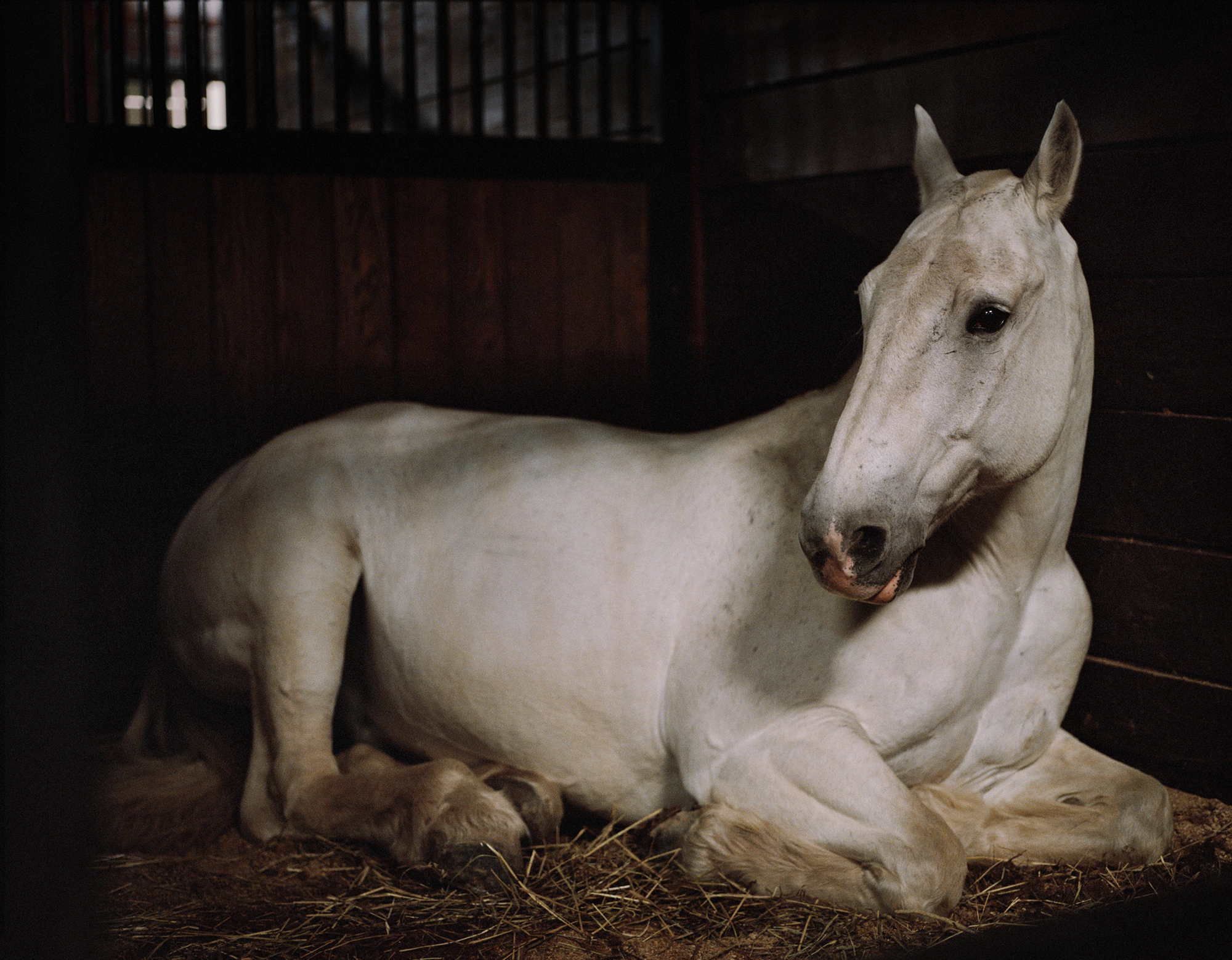
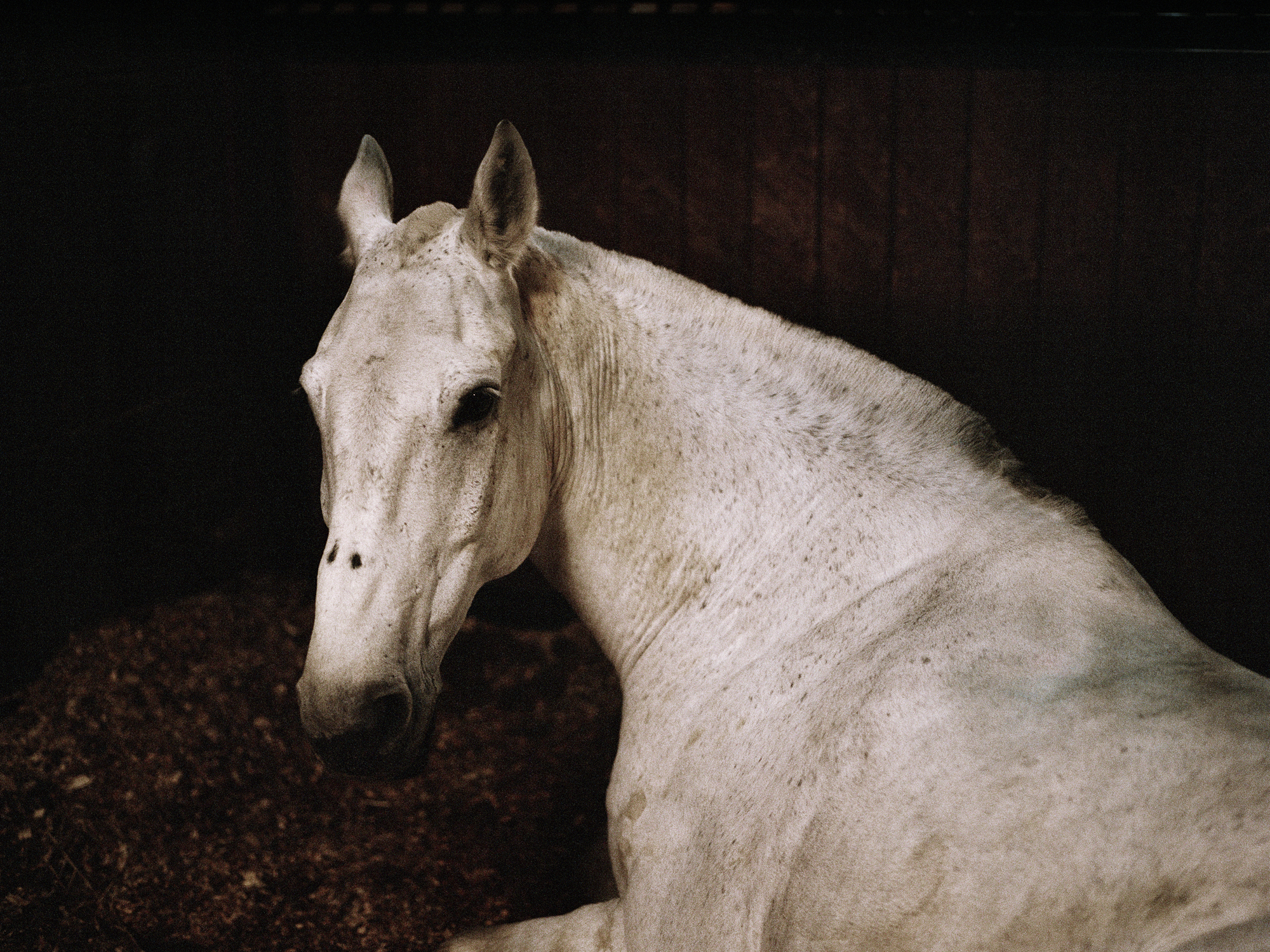
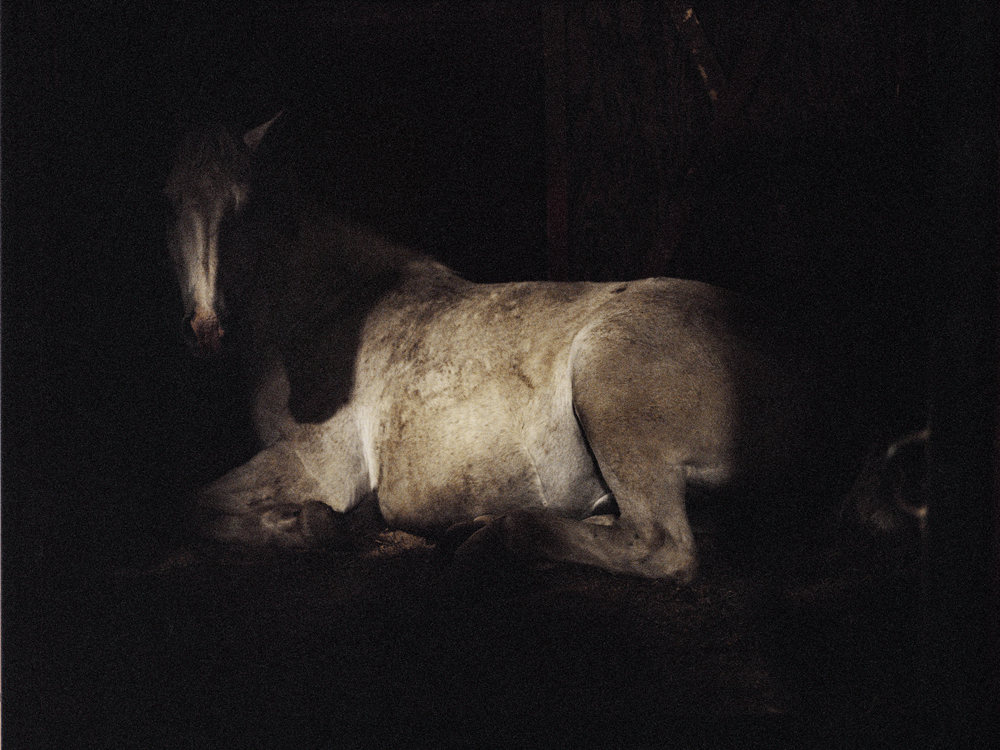
I returned on Sunday from a flying visit to Paris, during which time I visited an exhibition by Dutch photographer, Charlotte Dumas. On display were images from Dumas' series "Anima", in which she photographed horses at Arlington National Cemetery in Virginia. She made the images by sitting at the stable doors as the animals were resting and going to sleep at night. The photographs are displayed as large scale pieces, which when combined with the close-up nature in which they were shot makes them feel intimate and lifelike.
Also shown are the images from Dumas' "Retrieved" series in which she documents the dogs (now retired) who worked at the scene of the twin towers bombings, searching for survivors, bodies, and body parts.


I have commented on these images several times now, but each time I re-review this series I am always struck by the serenity and apparently stoical nature of the dogs. They are almost like "old soldiers" but when I think of what they did in their working lives, it all seems to make sense.
I have decided to add my comprehensive review of this exhibition (which has been a contextual assignment):-
Charlotte Dumas, “Anima” at Institut
Neerlandais, Paris. November 13th 2012 until January 20th
2013.
Exhibiting as part of
Paris Photo 2012, Dutch photographer Charlotte Dumas brings together several
series at the Instiut Neerlandais, under the title of “Anima”, which is the
taken from her series depicting the burial horses of Arlington National
Cemetery in Virginia. The images
of these horses were captured whilst they were resting at night, and they are
presented in the gallery as large prints.
Dumas sat by the stables of these animals over the course of 18 months
and just waited as they fell asleep in order to capture the images in the
series. (Dumas)
The horses are working
animals whose task it is to transport the coffins of fallen servicemen, who
have earned “full honours”. They
take part in up to eight funerals a day, year round. (Friedman, 2012)
According to Paul
Roth, curator at Corcoran Gallery of Art in Washington D.C, the portraits contravene
a photography “rule” never to photograph animals, as it usually evokes a
romantic notion in the viewer. (Dumas C. R., 2012). However, the images seen do not feel
romantic or sentimental, but peaceful and with a vaguely hypnotic feeling. Although shot in colour, the portraits
have a monochrome feel to them, as the white hair of the horses gradually fades
into the shadows of the stables where they rest. The close up nature in which they have been shot gives an
intimacy to the work, and this sense is further enhanced by the large-scale
presentation. There is a visible
grain in the images, but this doesn’t seem to detract from their effectiveness
in any way.
Within this section of
the exhibition is also a short video that simply shows the animals settling in
their stables. As with the photographs, the feeling evoked is one of calmness
and peace. The lighting and colour
palette are subtle and muted and the video and series of portraits together
leave the viewer feeling a quiet serenity, and a respect for the relationship
between these horses and the stricken men and women which they serve.
Rise Arlington
National Cemetery VA 2012
Ringo Arlington
National Cemetery VA 2012

Moving through the
white walled gallery the visitor can also view the “Retrieved” series, shot by
Dumas in 2011. This is another
series of animal portraits, but this time the subjects are dogs who worked at
the site of the twin towers bombings in 2001, searching for survivors, bodies
and body parts. Now retired, the
15 animals were photographed by Dumas in and around their homes in various
locations around America. The
resulting images show elderly dogs who appear to be calm and stoical in nature,
which, given the job that they performed in their working life, it can be
assumed that that is the case. In
most cases the dogs appear to be watchful, as if surveying the wider area and
taking in their environment. Greying muzzles and scarred coats emphasise the
advancing years of the subjects, and the composition, in which Dumas has been
careful to include details of surroundings that they have been pictured in,
reassure the viewer that not only did these dogs perform a valuable service
with their handlers in their younger years, but that they are also experiencing
a peaceful and fulfilling retirement, whether they are regally surveying a
scene (like Moxie, Winthrop MA), or taking a cooling dip in a lake, as is
Bailey of Franklin TN.
The composition of the photographs is
interesting, as Dumas has positioned the dogs fairly centrally in the image.
This has added strength to the series, through continuity.
One question that is
raised in the mind of the observer regarding these images is: are these dogs
exhibiting certain personality traits, or are we projecting our interpretation
onto the dog, given that we know a little of their background?
A question that would
only be possible to answer if the images were shown to a “blind “ observer, who
had not encountered the photographs before.
For example, in the
image of Orion (below), it could be suggested that the animal appears proud, as
his head is held high, and it might be assumed that this is a pride that has
originated from what he achieved during his working life. A more feasible explanation is
that here lies a dog, old and tired who is enjoying reclining in a few sparse
rays of sun. His raised head is
probably more likely to be an inquisitive manoeuvre, as he regards an
unfamiliar presence in his home (Dumas), or even as a response to a call or
noise from the photographer.
Orion, Vacaville, CA.
2011
Guinness, Highland CA. 2011
Bailey, Franklin TN. 2011
Moxie, Winthrop MA. 2011
Dumas collected newspaper cuttings of
pictures of the rescue dogs working at the site of the devastation as she felt
a connection to them.
“(The pictures) …gave a relief from all the
disaster and the heavy weight of this event…”
(Dumas C.
, A Pictoral Tribute to the Search and Rescue Dogs of 9/11, 2011)
The dogs not only fulfilled their task of
retrieval at the site, but also provided comfort to the firefighters working
there. In an interview with The
Telegraph (Australia), Dumas recollects a story about Bretagne, a golden
retriever, who comforted a firefighter in the rubble as he sat to catch his
breath. “Years later at a
remembrance ceremony, the same fireman recognized Bretagne and her handler and
they had a touching reunion” Dumas recalled. (Edwards,
2011)
The photographs in this series are
presented simply, float -mounted in black box frames.
“Retrieved” is a moving series of
photographs, displayed in a quiet gallery on a Paris side street. The images seem somewhat suited to the
calm, understated environment in which they are shown. Many people are dog owners or admirers,
and virtually everyone remembers the horror of 11th September
2001. These facts in combination
make this collection one that will surely strike a chord with most people, not
only art-lovers or photographers, and evoke a feeling of gratitude to these animals
who, by the nature of the species, live in the present – an attribute which
enabled them to undertake what was required of them in 2001.
Bibliography
Dumas,
C. (2011, September 10). A Pictoral Tribute to the Search and Rescue Dogs of
9/11. The Animal House. (S.
Williams, Interviewer)
Dumas, C. R. (2012 йил 20-August). A photo homage to the
working class ... of animals. The
Picture Show. (E. Friedman, Interviewer)
Dumas, C. (n.d.). Work.
Retrieved 2012 йил November from Charlotte Dumas:
http://www.charlottedumas.nl/work/
Edwards, A. (2011, September 6). Super dogs of the 9/11 disaster. Retrieved November 2012, from the
telegraph:
http://www.dailytelegraph.com.au/news/indepth/super-dogs-of-the-911-disaster/story-fn9q99nk-1226130127996
Friedman, E. (2012 йил 18-August). Photo Homage to the Working Class ... of Animals. (NPR) Retrieved
2012 йил November from the picture show:
http://www.npr.org/blogs/pictureshow/2012/08/18/159013613/a-photo-homage-to-the-working-class-of-animals


