Thursday, 13 December 2012
Editing and Post- Production
I realise that this post is a bit out of sync, as it comes after the printing post...
I used Lightroom for the majority of my editing and post processing. I has taken me a while to get used to it, but I have found that it has speeded up my workflow.
I made all of my main adjustments in Lightroom, and then used Photoshop to format my book pages.
Tools I use frequently in Lightroom are the gradient tool and adjustment brush, so I have started to create custom presets for these tools.
I have found the following websites helpful in teaching lightroom: Adobe TV,
http://tv.adobe.com/show/the-complete-picture-with-julieanne-kost/
and Creative Live
http://www.creativelive.com/
Creative Live courses are free if you watch them as they are being broadcast live, and they are really informative.


Wednesday, 12 December 2012
Book Production
My Hahnemuhle fine art inkjet album arrived. Printing it is turning out to be more time consuming than I had anticipated. I have spent a long time researching ICC profiles for various papers/printers, and how to soft proof. When I actually came to download the specific profile I needed, I became slightly unstuck as Hahnemuhle only provide the paper profiles for professional standard Canon inkjet printers. Mine is a Canon Pixma MP560.
This led me back to the internet to search on forums/discussions for any other users who had come across a similar issue. The consensus was, to use the setting "Matt Photo Paper", in absence of the correct specific profile.
I had already created a "mock-up" book, to help me with layout and ordering, I then did some test prints of my pages onto plain paper to make sure that the formatting looked OK and that I could print onto 2 sides correctly.
I think the prints look ok using the Matte paper setting, and the colours have been accurately reproduced.
Here are the settings I used:
A4 (borderless)
Matte photo paper
RIGHT HAND PAGES - need reverse orientation checking in "Layout" section of printer dialogue. This needs to be unchecked when printing the Left pages.

 drying the prints

This led me back to the internet to search on forums/discussions for any other users who had come across a similar issue. The consensus was, to use the setting "Matt Photo Paper", in absence of the correct specific profile.
I had already created a "mock-up" book, to help me with layout and ordering, I then did some test prints of my pages onto plain paper to make sure that the formatting looked OK and that I could print onto 2 sides correctly.
I think the prints look ok using the Matte paper setting, and the colours have been accurately reproduced.
Here are the settings I used:
A4 (borderless)
Matte photo paper
RIGHT HAND PAGES - need reverse orientation checking in "Layout" section of printer dialogue. This needs to be unchecked when printing the Left pages.

Printing the individual pages


mock-up of book
The book is assembled with brass screws, and so will assemble later when the prints have had time to settle.
Monday, 10 December 2012
Book making
Over the last few weeks I have been doing fairly extensive research into book making. If I had had enough time, I probably would have gone with a Blurb, or Bob books book as these are well known and respected companies, whose results come out well in several reviews. However, as the turnaround time is 7-11 days for these services , it wasn't going to work for this particular project. I do have presentation methods already at home, (cardboard portfolio box with archival sleeves, leather "book" portfolio, but I just feel that this series is best suited to a book format. I carried on my investigations, looking at (amongst other things), DS colour labs, and independent book binding services. DS have a quick turnaround of 1-5 days, but when I started the process of making a book, I encountered issues:- the advanced software that they ask you to download is for pc only, which seems crazy to me, as so many photographers are mac users. Another issue I encountered on the DS site was lack of choice available. For instance, they advertise books 12" x 16" in a choice of colours, but when you actually come to order the book, they only have white available.
I extended my research into self-print inkjet fine art albums, and decided that I would try this method. I feel that I am taking a risk with this, as the albums are pretty expensive,
Hahnemuhle inkjet album
I have purchased the Hahnemuhle book shown, so will print the images and then assemble the book. I have made books before in previous modules so am comfortable with page layout, gutter allowances etc.
This will be a good opportunity to try this method out, with the potential of using it again in my final project next year.
I extended my research into self-print inkjet fine art albums, and decided that I would try this method. I feel that I am taking a risk with this, as the albums are pretty expensive,
Hahnemuhle inkjet album
I have purchased the Hahnemuhle book shown, so will print the images and then assemble the book. I have made books before in previous modules so am comfortable with page layout, gutter allowances etc.
This will be a good opportunity to try this method out, with the potential of using it again in my final project next year.
Katie
This was an enjoyable shoot with Katie and her dog, Alfie. Alfie is a sweet natured and sensitive yorkshire terrier, and he was a perfect model, as was Katie. She was easy to direct, had a very natural look, and was comfortable in front of the camera. I started with OCF, and then moved to natural light, to give me plenty of images from which to choose.
'
Contacts


'
Contacts


a successful shoot which gave me lots of choice of images to use.
Lightroom plug in
I have been using Adobe Lightroom a lot more recently. I used to always use Bridge ->camera raw ACR)->Photoshop, but the more I use lightroom, the more I like it. It makes workflow much quicker, and all the edits are non-destructive.
Anyway, I have just purchased a plug-in called LR/Blog, which enables you to export images directly to your blog. A trial version is available, and the full version is about £9.
I haven't worked out how to paste images into an existing post (I've just emailed the creator to ask why), but can successfully start anew post with images straight from LR.
Get it here
The trial version limits image size to 300px, which I found frustrating, so I upgraded and now the images on the post entitled "Katie" came straight from LR with the long edge at 1000px.
Anyway, I have just purchased a plug-in called LR/Blog, which enables you to export images directly to your blog. A trial version is available, and the full version is about £9.
I haven't worked out how to paste images into an existing post (I've just emailed the creator to ask why), but can successfully start anew post with images straight from LR.
Get it here
The trial version limits image size to 300px, which I found frustrating, so I upgraded and now the images on the post entitled "Katie" came straight from LR with the long edge at 1000px.
Ruth
I had arranged to photograph Ruth and her dog, but when I arrived she asked me if I wanted to photograph her daughter with the dog instead. I can't post the images here due to legal implications (my blog is public), but the contact sheets will be submitted with my final piece.
I used natural lighting indoors, and took as many shots as I could within the limited time of a two-year olds attention span. I was pleased with the results, and feel like these images constitute some of the strongest so far.
My workbook that supplements this blog will contain more details of this shoot.
I used natural lighting indoors, and took as many shots as I could within the limited time of a two-year olds attention span. I was pleased with the results, and feel like these images constitute some of the strongest so far.
My workbook that supplements this blog will contain more details of this shoot.
Sharon
'
'
' '
' '
Sharon is a photographer friend, who is always very helpful with ideas and knowledge. She was very patient as I experimented with lighting, umbrellas, reflectors etc., even when her dog became spooked by a bang, and wanted to flee. I like the lighting that achieved in the final image I selected, as I think Sharon and Poppy "pop" out of the background nicely. Sharon's website
' '
' '
Sharon is a photographer friend, who is always very helpful with ideas and knowledge. She was very patient as I experimented with lighting, umbrellas, reflectors etc., even when her dog became spooked by a bang, and wanted to flee. I like the lighting that achieved in the final image I selected, as I think Sharon and Poppy "pop" out of the background nicely. Sharon's website
Helen
Contacts


This was a family shoot with dog as I thought of incorporating a family into my final project, however, in retrospect I prefer the images where it is just the couple with their dog. I think it has a greater feeling of intimacy, and bonding which fits in better with my theme of "health".
Charlotte
Another shoot with a high energy dog.. The owner didn't want the dog to get dirty paws, and so I did the shoot just on a tarmac road. I am finding these (my own opinion) under-exercised dogs a challenge, and for the future I will be suggesting that the dogs arrive for the shoot tired. On a side note, I have a keen interest in dog behaviour, and believe that many issues that dogs have are caused, or made worse by, insufficient exercise, but don't get me started on dog behaviour!
Back to the point...I am seeing the same poses emerging time after time, as the owner has no option other than to crouch and restrain the dog, in order to get him in shot. This really takes any control or direction away from me. The contact sheets I end up with are all variations of exactly the same shot, and, to be honest, I am willing the shoot to be over because it's stressful for the owner, as they perceive their dog to be "naughty", or not doing as it's told.
Sorry if this post sounds like a rant.
Ok, so now I have a confession....several of the people who have volunteered to be photographed have also asked for a photo "for their Mum", so of course I've ended up doing loads of shots which are absolutely nothing to do with my project, as you will see from these contacts...


Back to the point...I am seeing the same poses emerging time after time, as the owner has no option other than to crouch and restrain the dog, in order to get him in shot. This really takes any control or direction away from me. The contact sheets I end up with are all variations of exactly the same shot, and, to be honest, I am willing the shoot to be over because it's stressful for the owner, as they perceive their dog to be "naughty", or not doing as it's told.
Sorry if this post sounds like a rant.
Ok, so now I have a confession....several of the people who have volunteered to be photographed have also asked for a photo "for their Mum", so of course I've ended up doing loads of shots which are absolutely nothing to do with my project, as you will see from these contacts...


The Writing Bit
Within my final project presentation, I intend to document what the benefits (proven or anecdotal) of owning a dog actually are. For this I have been looking at articles published online.
The ones that are talked about most frequently include;
1) Lowered blood pressure
2) Lower cholesterol
3) Reduction in stress
4)Help with depression
5) Reduced allergies and asthma
Further research uncovers studies that have found that children who families own pets have better attendance at school. (http://news.bbc.co.uk/1/hi/england/coventry_warwickshire/3731058.stm), and that pets help people in coming to terms with bereavement. (http://news.bbc.co.uk/1/hi/health/3702923.stm)
Researchers in Japan have found that pet owners who are bonded with their dog experience a spike in oxytocin (a neurotransmitter that helps us deal with stress), just by making eye contact with them. (http://www.huffingtonpost.com/2012/04/21/health-benefits-dogs_n_1421573.html)
Dogs also help with social interactions, as dog walking can be a very social pastime as people, who would otherwise be strangers, stop to chat to dog walkers.
The researchers are not not certain why owning a dog provides these benefits, and suggest it may have something to do with the walking involved in owning a dog. Walking certainly can help with weight management and general mobility, and my personal opinion is that it also can be helpful in the prevention of Seasonal Affective Disorder, due to exposure to light when walking.
In addition to the benefits I have listed above, there are also medical assistance dogs, who are trained to detect changes in blood sugar in diabetics, to alert epileptic patients to an impending seizure, and even to detect cancer. http://medicaldetectiondogs.org.uk
This is something I may investigate further for my final project next year.
Whilst speaking to the people who have taken part in my project, I have been asking them for their view on how owning a dog benefits them. The responses I have received have included;
"When no-one else is home, he's good company, and makes me feel more secure" (Katie, 15)
and
"He can tell when I'm feeling really down..." (A manic depression sufferer)
The ones that are talked about most frequently include;
1) Lowered blood pressure
2) Lower cholesterol
3) Reduction in stress
4)Help with depression
5) Reduced allergies and asthma
Further research uncovers studies that have found that children who families own pets have better attendance at school. (http://news.bbc.co.uk/1/hi/england/coventry_warwickshire/3731058.stm), and that pets help people in coming to terms with bereavement. (http://news.bbc.co.uk/1/hi/health/3702923.stm)
Researchers in Japan have found that pet owners who are bonded with their dog experience a spike in oxytocin (a neurotransmitter that helps us deal with stress), just by making eye contact with them. (http://www.huffingtonpost.com/2012/04/21/health-benefits-dogs_n_1421573.html)
Dogs also help with social interactions, as dog walking can be a very social pastime as people, who would otherwise be strangers, stop to chat to dog walkers.
The researchers are not not certain why owning a dog provides these benefits, and suggest it may have something to do with the walking involved in owning a dog. Walking certainly can help with weight management and general mobility, and my personal opinion is that it also can be helpful in the prevention of Seasonal Affective Disorder, due to exposure to light when walking.
In addition to the benefits I have listed above, there are also medical assistance dogs, who are trained to detect changes in blood sugar in diabetics, to alert epileptic patients to an impending seizure, and even to detect cancer. http://medicaldetectiondogs.org.uk
This is something I may investigate further for my final project next year.
Whilst speaking to the people who have taken part in my project, I have been asking them for their view on how owning a dog benefits them. The responses I have received have included;
"When no-one else is home, he's good company, and makes me feel more secure" (Katie, 15)
and
"He can tell when I'm feeling really down..." (A manic depression sufferer)
Friday, 7 December 2012
Exhibition visit - Charlie Meecham
People's History Museum, Manchester.
Charlie Meecham made a series of photographs in the mid-1980's documenting Oldham Road, that runs between Oldham and Manchester. In the last couple of years (images on display taken 2010 and 2011) he has revisited the road and made a new series of images, which are displayed each with one of the original photographs. The exhibition is a simple one in terms of display methodology - the images have been printed on to (?fine art) card, and are pinned to display boards in the centre of the gallery. A free brochure is available at the museum reception, and this gives a fairly comprehensive insight not only into Meecham's work, but also into the history of the Oldham Road and industry in Oldham through the centuries, and how the changes seen in this industry consequently shaped the landscapes and lifestyles of the residents and business owners who call this road home.


Charlie Meecham made a series of photographs in the mid-1980's documenting Oldham Road, that runs between Oldham and Manchester. In the last couple of years (images on display taken 2010 and 2011) he has revisited the road and made a new series of images, which are displayed each with one of the original photographs. The exhibition is a simple one in terms of display methodology - the images have been printed on to (?fine art) card, and are pinned to display boards in the centre of the gallery. A free brochure is available at the museum reception, and this gives a fairly comprehensive insight not only into Meecham's work, but also into the history of the Oldham Road and industry in Oldham through the centuries, and how the changes seen in this industry consequently shaped the landscapes and lifestyles of the residents and business owners who call this road home.
Travelling home, I noticed this old fashioned shop in the Padgate area of Warrington so I took a quick snap with my iphone through the rainy car window! It reminded me of Meecham's Oldham Road series.
To see more of Meecham's work visit his website.
Monday, 3 December 2012
Bev
This was the trickiest shoot to date. Used OCF but struggled to get exposure correct, without reflections off the wardrobe doors.
Took owner and dog outside, but as dog hadn't been exercised, it was hard to get her still enough to get in shot with owner.
Unedited images
'
' '
' '
This project is teaching me something though - this type of photography is very difficult to undertake on high energy dogs that have not been exercised, and therefore I need to be more assertive about when the sessions take place.. I think this will be easier when and if I have paying clients.
The other lesson I am learning is that when people book a shoot with me, I intend to take a deposit at the time of booking, because I have been cancelled, postponed, rebooked several times already during the course of this project.
My heart wants to ditch the flash and stick to beautiful, natural light...but my head says if I keep on with flash I might master it someday!!...which reminds me, a friend sent me this link which I must go and check out to brush up my flash skills.
Took owner and dog outside, but as dog hadn't been exercised, it was hard to get her still enough to get in shot with owner.
Unedited images
'
' '
' '
This project is teaching me something though - this type of photography is very difficult to undertake on high energy dogs that have not been exercised, and therefore I need to be more assertive about when the sessions take place.. I think this will be easier when and if I have paying clients.
The other lesson I am learning is that when people book a shoot with me, I intend to take a deposit at the time of booking, because I have been cancelled, postponed, rebooked several times already during the course of this project.
My heart wants to ditch the flash and stick to beautiful, natural light...but my head says if I keep on with flash I might master it someday!!...which reminds me, a friend sent me this link which I must go and check out to brush up my flash skills.
Julie
unedited images: shortlist
'
' '
' '
' '
' '
' '
' '
I shot these images with natural light as i) Julie has a conservatory which is decorated in her taste, and reflects her personality and values and ii) the dog, Pippa, is quite literally camera shy, and I didn't want to make her more uncomfortable with flash. She didn't like the lens pointing at her, and turned her head accordingly each time. The images to me represent the need for companionship and the importance of family.
'
' '
' '
' '
' '
' '
' '
I shot these images with natural light as i) Julie has a conservatory which is decorated in her taste, and reflects her personality and values and ii) the dog, Pippa, is quite literally camera shy, and I didn't want to make her more uncomfortable with flash. She didn't like the lens pointing at her, and turned her head accordingly each time. The images to me represent the need for companionship and the importance of family.
Amy
This shoot was with a "stranger" that contacted me through Facebook to volunteer for my shoot. Amy has manic depression and curvature of the spine, and is registered disabled. I arrived at her house and despite knocking (loudly) for about 15 minutes, nobody answered. (I had travelled about 50mins by car to get to her house). I felt really disappointed, as sitting in the front window was a beautiful siberian husky. I took a sneaky snap with my phone.
.
After 40 mins of waiting in my car, and just about to leave, Amy arrived, full of apologies. By this time I only had 30 minutes before I had to go to collect kids from school, so we went to the local park and I took some images of Amy and Rain. Natural light only.
Here are some images with minimal Lightroom adjustments.
 I like this one. I have placed her at the foot of the steps, which could signify an uphill battle with depression and/or mobility. (Her spine problem can keep her bedridden for days at a time). Desaturated slightly.


.
After 40 mins of waiting in my car, and just about to leave, Amy arrived, full of apologies. By this time I only had 30 minutes before I had to go to collect kids from school, so we went to the local park and I took some images of Amy and Rain. Natural light only.
Here are some images with minimal Lightroom adjustments.
Overlooking Accrington.
The dog was young and energetic, and this made the shoot harder as the dog was obsessing about looking at everything else happening on the park and not a me, despite my best cat, bird and mouse noises.
Another factor which made this shoot less than ideal was the limited time in which I had to work. However, Amy was a lovely girl to meet and did as directed.
Thursday, 29 November 2012
Been Shooting
The good news is... I have done some shoots with folks and their dogs. The bad news is...the results have been hit and miss. Various issues - people postponing, people arriving late and the biggest one my lack of success with OCF. I keep trying it out but the results aren't great. Has anyone got any suggestions?
Here is an amalgamation of a few of the better shots from my shoots. It remains to be seen how I'm going to pull it all together into a series.

Here is an amalgamation of a few of the better shots from my shoots. It remains to be seen how I'm going to pull it all together into a series.

Goodnight
Monday, 26 November 2012
Shoot
Click to see my contact sheet.
This shoot was a little frustrating at first. I was using OCF by a fairly windy Manchester Ship canal and I had a few difficulties...
The fact that I was using a large brolly on a lightstand meant that the wind was causing me big problems. Ended up weighing lightstand down with bricks.
Also am finding lighting standing adult, and sitting or lying dog quite difficult with one speedlight. I may need to review my OCF set up to light both satisfactorily.
 I ended the shoot in the owner's home, so that I have a range of images to choose from.
This shoot was a little frustrating at first. I was using OCF by a fairly windy Manchester Ship canal and I had a few difficulties...
The fact that I was using a large brolly on a lightstand meant that the wind was causing me big problems. Ended up weighing lightstand down with bricks.
Also am finding lighting standing adult, and sitting or lying dog quite difficult with one speedlight. I may need to review my OCF set up to light both satisfactorily.

Fresh Inspiration
Daniel Naude´ Animal Farm
whilst visiting the Tate last week to see the Klein/Moriyama retrospective, I used a few spare minutes to browse the extensive bookshop. Here I happened upon Animal farm, by Daniel Naude´, a series in which the photographer has explored the relationship between animals and man, and learned of South African historical stories involving domesticated animals.


I like the lighting and the detail in these images, and the reference to man's interdependent relationship with animals.
whilst visiting the Tate last week to see the Klein/Moriyama retrospective, I used a few spare minutes to browse the extensive bookshop. Here I happened upon Animal farm, by Daniel Naude´, a series in which the photographer has explored the relationship between animals and man, and learned of South African historical stories involving domesticated animals.
I like the lighting and the detail in these images, and the reference to man's interdependent relationship with animals.
Exhibition Visit - Charlotte Dumas
I returned on Sunday from a flying visit to Paris, during which time I visited an exhibition by Dutch photographer, Charlotte Dumas. On display were images from Dumas' series "Anima", in which she photographed horses at Arlington National Cemetery in Virginia. She made the images by sitting at the stable doors as the animals were resting and going to sleep at night. The photographs are displayed as large scale pieces, which when combined with the close-up nature in which they were shot makes them feel intimate and lifelike.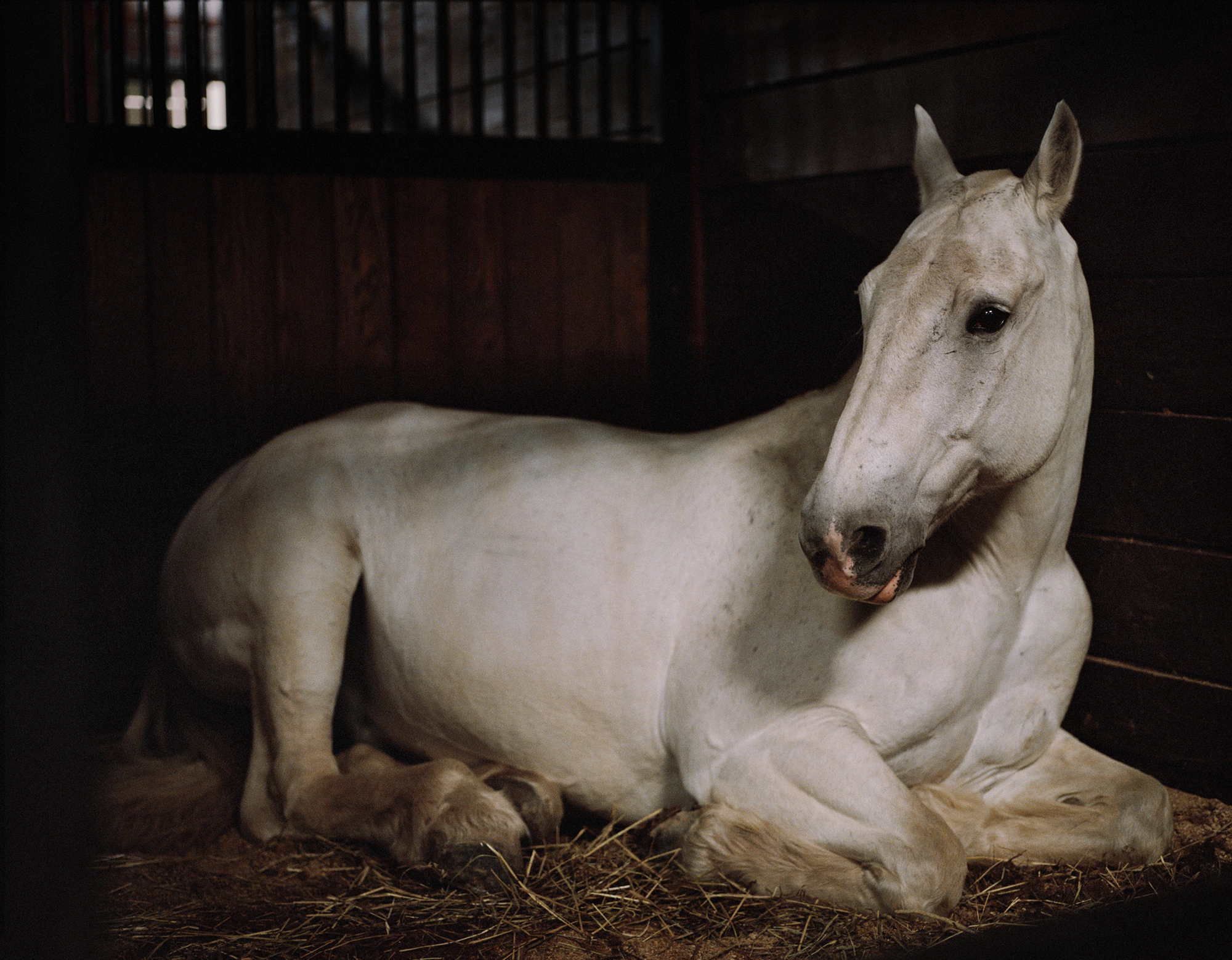
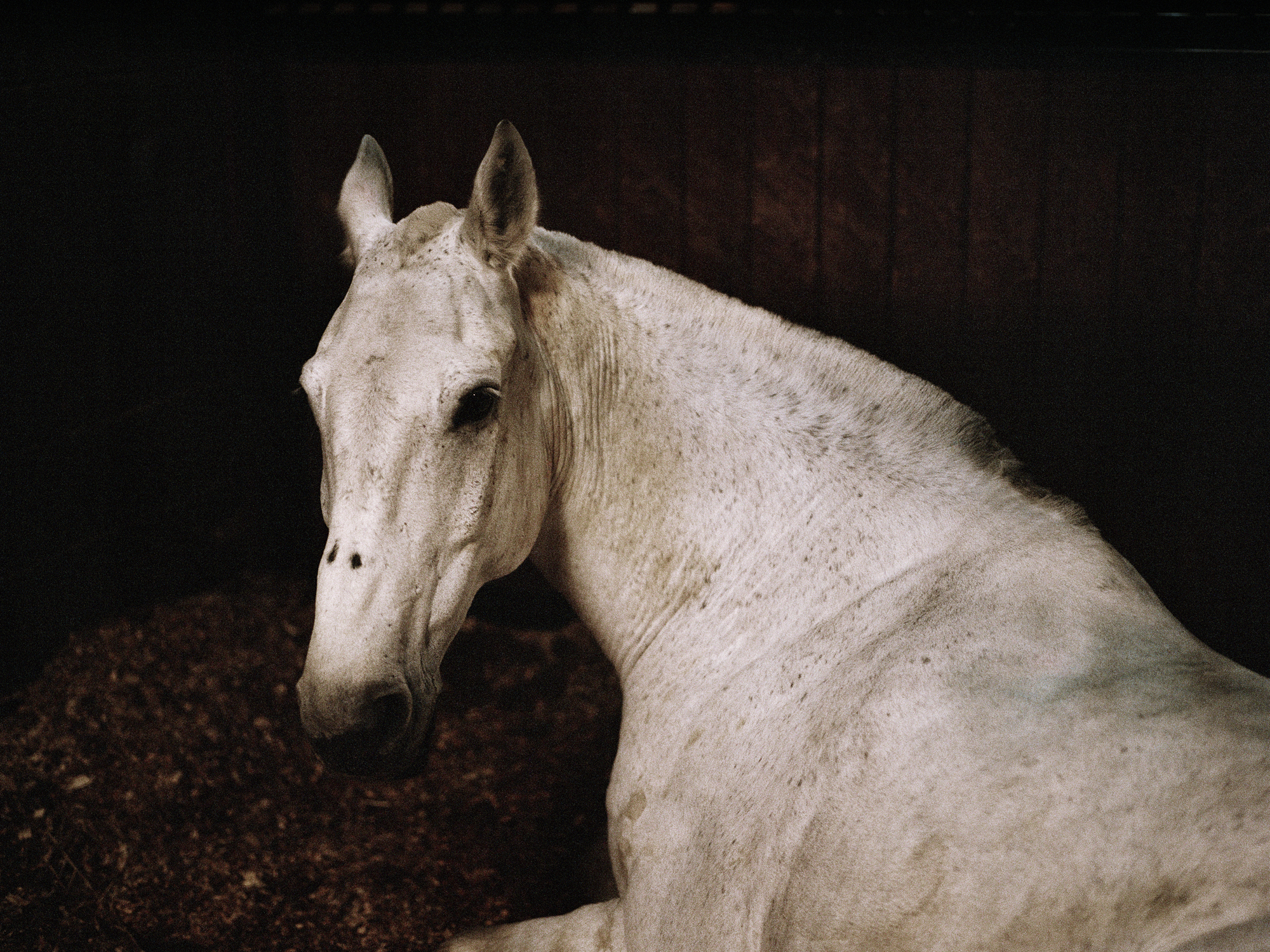
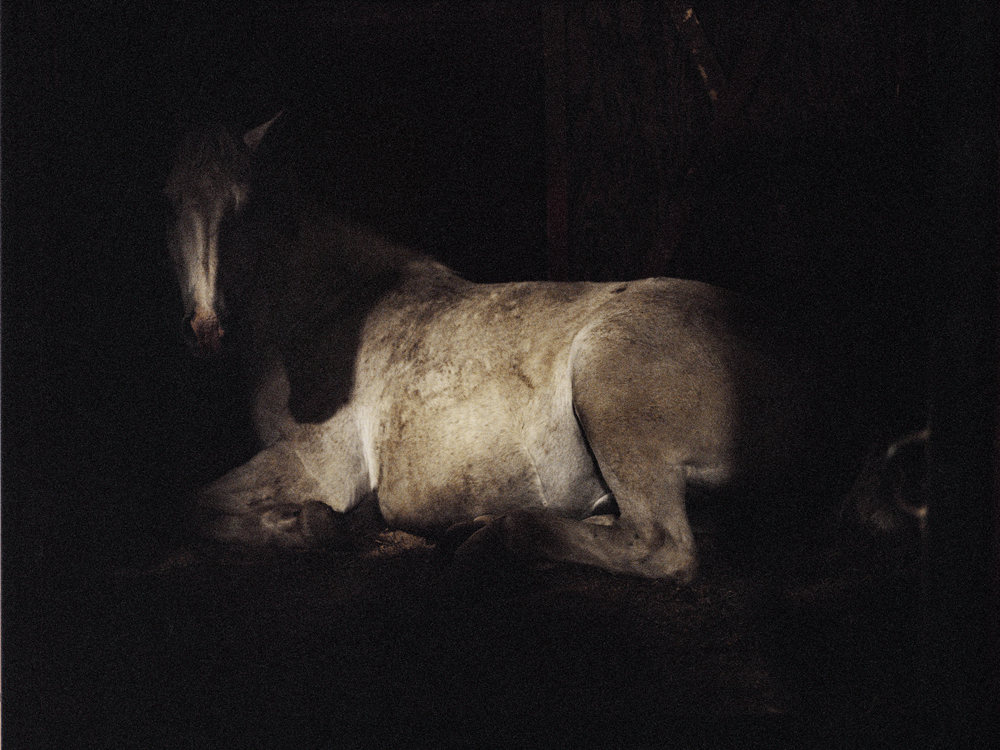
Also shown are the images from Dumas' "Retrieved" series in which she documents the dogs (now retired) who worked at the scene of the twin towers bombings, searching for survivors, bodies, and body parts.


I have commented on these images several times now, but each time I re-review this series I am always struck by the serenity and apparently stoical nature of the dogs. They are almost like "old soldiers" but when I think of what they did in their working lives, it all seems to make sense.
I have decided to add my comprehensive review of this exhibition (which has been a contextual assignment):-


(Dumas C.
, A Pictoral Tribute to the Search and Rescue Dogs of 9/11, 2011)

Also shown are the images from Dumas' "Retrieved" series in which she documents the dogs (now retired) who worked at the scene of the twin towers bombings, searching for survivors, bodies, and body parts.
I have commented on these images several times now, but each time I re-review this series I am always struck by the serenity and apparently stoical nature of the dogs. They are almost like "old soldiers" but when I think of what they did in their working lives, it all seems to make sense.
I have decided to add my comprehensive review of this exhibition (which has been a contextual assignment):-
Charlotte Dumas, “Anima” at Institut
Neerlandais, Paris. November 13th 2012 until January 20th
2013.
Exhibiting as part of
Paris Photo 2012, Dutch photographer Charlotte Dumas brings together several
series at the Instiut Neerlandais, under the title of “Anima”, which is the
taken from her series depicting the burial horses of Arlington National
Cemetery in Virginia. The images
of these horses were captured whilst they were resting at night, and they are
presented in the gallery as large prints.
Dumas sat by the stables of these animals over the course of 18 months
and just waited as they fell asleep in order to capture the images in the
series. (Dumas)
The horses are working
animals whose task it is to transport the coffins of fallen servicemen, who
have earned “full honours”. They
take part in up to eight funerals a day, year round. (Friedman, 2012)
According to Paul
Roth, curator at Corcoran Gallery of Art in Washington D.C, the portraits contravene
a photography “rule” never to photograph animals, as it usually evokes a
romantic notion in the viewer. (Dumas C. R., 2012) . However, the images seen do not feel
romantic or sentimental, but peaceful and with a vaguely hypnotic feeling. Although shot in colour, the portraits
have a monochrome feel to them, as the white hair of the horses gradually fades
into the shadows of the stables where they rest. The close up nature in which they have been shot gives an
intimacy to the work, and this sense is further enhanced by the large-scale
presentation. There is a visible
grain in the images, but this doesn’t seem to detract from their effectiveness
in any way.
Within this section of
the exhibition is also a short video that simply shows the animals settling in
their stables. As with the photographs, the feeling evoked is one of calmness
and peace. The lighting and colour
palette are subtle and muted and the video and series of portraits together
leave the viewer feeling a quiet serenity, and a respect for the relationship
between these horses and the stricken men and women which they serve.
Rise Arlington
National Cemetery VA 2012
Ringo Arlington
National Cemetery VA 2012
Buck Arlington
National Cemetery VA 2012. From www.charlottedumas.nl
Moving through the
white walled gallery the visitor can also view the “Retrieved” series, shot by
Dumas in 2011. This is another
series of animal portraits, but this time the subjects are dogs who worked at
the site of the twin towers bombings in 2001, searching for survivors, bodies
and body parts. Now retired, the
15 animals were photographed by Dumas in and around their homes in various
locations around America. The
resulting images show elderly dogs who appear to be calm and stoical in nature,
which, given the job that they performed in their working life, it can be
assumed that that is the case. In
most cases the dogs appear to be watchful, as if surveying the wider area and
taking in their environment. Greying muzzles and scarred coats emphasise the
advancing years of the subjects, and the composition, in which Dumas has been
careful to include details of surroundings that they have been pictured in,
reassure the viewer that not only did these dogs perform a valuable service
with their handlers in their younger years, but that they are also experiencing
a peaceful and fulfilling retirement, whether they are regally surveying a
scene (like Moxie, Winthrop MA), or taking a cooling dip in a lake, as is
Bailey of Franklin TN.
The composition of the photographs is
interesting, as Dumas has positioned the dogs fairly centrally in the image.
This has added strength to the series, through continuity.
One question that is
raised in the mind of the observer regarding these images is: are these dogs
exhibiting certain personality traits, or are we projecting our interpretation
onto the dog, given that we know a little of their background?
A question that would
only be possible to answer if the images were shown to a “blind “ observer, who
had not encountered the photographs before.
For example, in the
image of Orion (below), it could be suggested that the animal appears proud, as
his head is held high, and it might be assumed that this is a pride that has
originated from what he achieved during his working life. A more feasible explanation is
that here lies a dog, old and tired who is enjoying reclining in a few sparse
rays of sun. His raised head is
probably more likely to be an inquisitive manoeuvre, as he regards an
unfamiliar presence in his home (Dumas), or even as a response to a call or
noise from the photographer.
Orion, Vacaville, CA.
2011
Guinness, Highland CA. 2011
Bailey, Franklin TN. 2011
Moxie, Winthrop MA. 2011
Dumas collected newspaper cuttings of
pictures of the rescue dogs working at the site of the devastation as she felt
a connection to them.
“(The pictures) …gave a relief from all the
disaster and the heavy weight of this event…”
The dogs not only fulfilled their task of
retrieval at the site, but also provided comfort to the firefighters working
there. In an interview with The
Telegraph (Australia), Dumas recollects a story about Bretagne, a golden
retriever, who comforted a firefighter in the rubble as he sat to catch his
breath. “Years later at a
remembrance ceremony, the same fireman recognized Bretagne and her handler and
they had a touching reunion” Dumas recalled. (Edwards,
2011)
The photographs in this series are
presented simply, float -mounted in black box frames.
Image taken from www.dailytelegraph.com.au Photographer unknown.
“Retrieved” is a moving series of
photographs, displayed in a quiet gallery on a Paris side street. The images seem somewhat suited to the
calm, understated environment in which they are shown. Many people are dog owners or admirers,
and virtually everyone remembers the horror of 11th September
2001. These facts in combination
make this collection one that will surely strike a chord with most people, not
only art-lovers or photographers, and evoke a feeling of gratitude to these animals
who, by the nature of the species, live in the present – an attribute which
enabled them to undertake what was required of them in 2001.
Bibliography
Dumas,
C. (2011, September 10). A Pictoral Tribute to the Search and Rescue Dogs of
9/11. The Animal House. (S.
Williams, Interviewer)
Dumas, C. R. (2012 йил 20-August). A photo homage to the
working class ... of animals. The
Picture Show. (E. Friedman, Interviewer)
Dumas, C. (n.d.). Work.
Retrieved 2012 йил November from Charlotte Dumas:
http://www.charlottedumas.nl/work/
Edwards, A. (2011, September 6). Super dogs of the 9/11 disaster. Retrieved November 2012, from the
telegraph:
http://www.dailytelegraph.com.au/news/indepth/super-dogs-of-the-911-disaster/story-fn9q99nk-1226130127996
Friedman, E. (2012 йил 18-August). Photo Homage to the Working Class ... of Animals. (NPR) Retrieved
2012 йил November from the picture show:
http://www.npr.org/blogs/pictureshow/2012/08/18/159013613/a-photo-homage-to-the-working-class-of-animals
Subscribe to:
Comments (Atom)